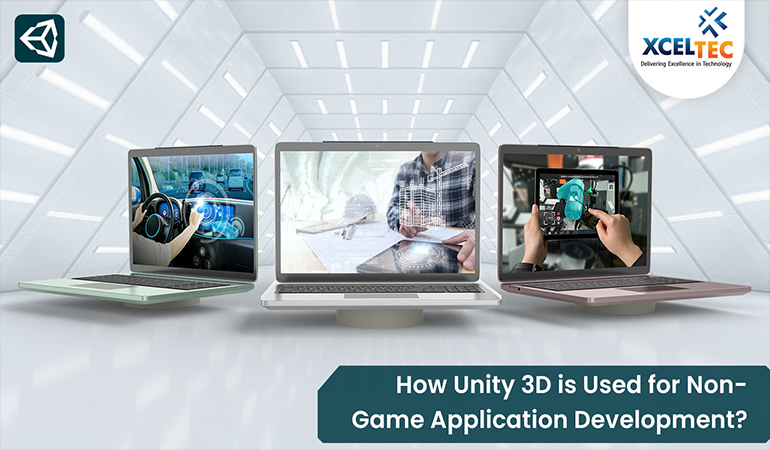
How is Unity 3D Used for Non-Game Application Development?
How Unity 3D Is Transforming Non-Gaming Mobile App Development
Over the past few years, the mobile application development landscape has changed significantly. Businesses are no longer limited to traditional 2D interfaces and standard application experiences. With advancements in 3D technologies, augmented reality (AR), virtual reality (VR), real-time rendering, artificial intelligence, and immersive digital experiences, developers now have new opportunities to build highly interactive applications.
One technology that is helping drive this transformation is Unity.
Originally recognised as one of the world’s leading game development engines, Unity has evolved into a powerful real-time development platform capable of building much more than games. Today, businesses and developers use Unity to create interactive mobile applications, educational tools, architectural visualisations, industrial training solutions, marketing experiences, simulations, and immersive AR/VR applications.
What Is Unity?
Unity is a real-time development platform used to create interactive 2D and 3D experiences for multiple platforms. It provides developers with a powerful environment that includes tools for:
- 2D and 3D development
- Real-time rendering
- Animation
- Physics simulation
- Augmented reality
- Virtual reality
- Interactive visualisation
- Cross-platform deployment
Unity primarily uses C# for scripting and provides an integrated development environment that enables developers, designers, artists, and technical teams to collaborate on interactive digital experiences.
Although Unity became widely popular in the gaming industry, its capabilities now extend across multiple sectors.
Why Use Unity for Non-Gaming Applications?
Unity is particularly useful when an application requires rich visuals, real-time interaction, 3D content, simulations, or immersive experiences.
Traditional mobile development frameworks are excellent for standard business applications, such as forms, dashboards, e-commerce platforms, and content-based applications. However, when an application requires advanced 3D visualisation or real-time interactive content, Unity can provide significant advantages.
1. Powerful 2D and 3D Capabilities
Unity provides a comprehensive environment for building interactive 2D and 3D experiences.
Businesses can use Unity to create:
- 3D product visualisations
- Virtual environments
- Interactive training modules
- Architectural walkthroughs
- Digital twins
- Simulations
- AR product experiences
These experiences can make applications more engaging and visually interactive than traditional mobile interfaces.
2. Cross-Platform Development
One of Unity’s biggest advantages is its ability to support multiple platforms from a shared development environment.
Depending on the project requirements, Unity applications can be developed for:
- Android
- iOS
- Windows
- macOS
- Web platforms
- AR devices
- VR headsets
- Other supported platforms
This can help businesses reduce duplicated development efforts and create consistent experiences across different devices.
3. Faster Development with C#
Unity primarily uses C#, a widely used programming language with a large developer community.
The combination of C# scripting and Unity’s visual development environment allows developers to create interactive features efficiently. Developers can control:
- User interactions
- Animations
- Object behaviour
- Data integration
- Camera systems
- Physics
- AR/VR interactions
Modern Unity workflows also support reusable components and modular development, helping development teams build applications more efficiently.
4. Visual Development Environment
Unity provides a visual editor that allows developers and designers to work with objects, scenes, animations, cameras, lights, and other elements.
This can make the development process more collaborative. Designers can visualise the application environment while developers implement the required functionality.
The ability to preview changes in real time can also help teams identify issues earlier during development.
5. AR and VR Development
One of the most important reasons businesses are adopting Unity is its support for immersive technologies.
Unity can be used to develop:
- Augmented reality applications
- Virtual reality applications
- Mixed reality experiences
- Interactive product demonstrations
- Immersive training environments
With AR, digital content can be placed within the user’s physical environment. For example, a customer may use a mobile application to visualise furniture inside their home or explore a 3D product before making a purchase.
VR can create fully immersive environments for training, education, simulations, and enterprise applications.
Types of Non-Gaming Applications Built with Unity
Unity can be used across a wide range of industries.
Educational Applications
Educational institutions can use Unity to create interactive learning experiences.
Examples include:
- 3D learning environments
- Virtual laboratories
- Interactive science applications
- Historical simulations
- Medical education tools
Interactive learning can make complex concepts easier to understand through visualisation and interaction.
Home Design and Architecture Applications
Unity can be used to create interactive 3D environments for architecture and interior design.
Users can:
- Explore virtual properties
- View 3D floor plans
- Change furniture
- Modify colours and materials
- Experience virtual walkthroughs
This provides customers with a more engaging way to visualise a space before construction or purchase.
Marketing and Product Visualisation
Brands can use Unity to create interactive marketing experiences.
For example, businesses can develop applications that allow customers to:
- Explore products in 3D
- Interact with virtual models
- Experience AR product demonstrations
- View product features interactively
This can help companies create more memorable customer experiences.
Industrial Training Applications
Unity is increasingly used for training and simulation.
Businesses can create virtual environments for:
- Equipment training
- Safety training
- Employee onboarding
- Industrial simulations
- Emergency response training
Employees can practise procedures in a controlled digital environment before working in real-world situations.
Healthcare and Medical Applications
Unity can also be used to create interactive medical visualisations and training applications.
Potential use cases include:
- Medical education
- 3D anatomy visualisation
- Surgical training simulations
- Patient education
- Rehabilitation experiences
These applications can help present complex medical information in a more interactive format.
Location-Based Applications
Unity can be used to create interactive navigation and location-based experiences.
For example, large buildings such as airports, hospitals, shopping malls, and universities can use interactive applications to help users navigate complex environments.
These applications may combine 3D maps, location services, AR, and interactive directions.
Unity and Modern Technologies
Unity’s future in non-gaming application development is closely connected to emerging technologies.
Modern Unity projects can integrate technologies such as:
- Artificial intelligence
- Augmented reality
- Virtual reality
- Spatial computing
- Real-time 3D rendering
- Cloud services
- IoT systems
- Digital twins
- Computer vision
As businesses increasingly look for immersive and interactive digital experiences, real-time 3D platforms are becoming valuable beyond traditional gaming.
Is Unity Suitable for Business Applications?
Unity is not the ideal choice for every type of business application. A traditional business application such as a simple CRM, accounting system, or content management platform may be better developed using conventional web or mobile technologies.
However, Unity can be an excellent choice when the application requires:
- Advanced 3D graphics
- Real-time interaction
- AR or VR
- Simulation
- 3D visualisation
- Immersive training
- Interactive product experiences
The right technology should always be selected according to the application’s business goals, performance requirements, target platforms, and user experience expectations.
Conclusion
Unity has evolved far beyond its original reputation as a game development engine. Its powerful real-time 2D and 3D capabilities make it a valuable platform for developing immersive and interactive applications across multiple industries.
From education and healthcare to architecture, marketing, industrial training, and enterprise solutions, Unity enables businesses to create experiences that traditional application frameworks may not be able to deliver as effectively.
With the growing adoption of AR, VR, spatial computing, artificial intelligence, digital twins, and real-time 3D experiences, Unity is likely to continue playing an important role in the future of interactive application development.
At XcelTec, we help businesses explore the possibilities of Unity, AR, VR, and immersive technologies to create innovative digital experiences tailored to their business objectives.
Get in touch with us for more!
Contact us on: +91 987 979 9459 | +1 919 400 9200
Email us at: sales@xceltec.com
Frequently Asked Questions
1. Can Unity be used to develop applications other than games?
Yes. Unity can be used to develop educational applications, architectural visualisations, healthcare solutions, training simulations, AR/VR experiences, marketing applications, and other interactive 2D and 3D applications.
2. Why is Unity useful for AR and VR application development?
Unity provides tools for real-time 3D rendering, interactive environments, animations, physics, and immersive experiences. These capabilities make it suitable for developing AR, VR, and mixed reality applications.
3. What programming language is used for Unity development?
C# is the primary programming language used for Unity development. Developers use C# to create application logic, interactions, animations, integrations, and other interactive features.
4. Is Unity suitable for enterprise application development?
Unity can be suitable for enterprise applications that require 3D visualisation, simulation, immersive training, digital twins, AR, VR, or interactive experiences. For standard business applications without these requirements, other web and mobile development technologies may be more appropriate.