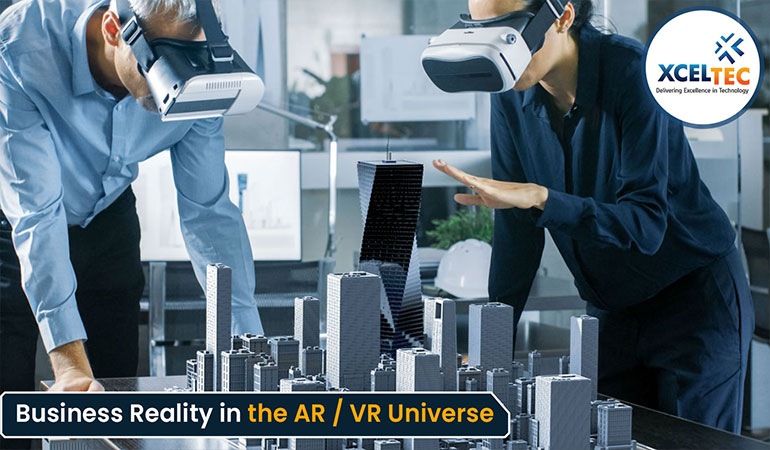
Business Reality in the AR / VR Universe
Business Reality in the AR/VR Universe: Transforming Customer Experiences and Sales
Augmented Reality (AR) and Virtual Reality (VR) are no longer limited to gaming and entertainment. These immersive technologies are becoming powerful business tools that are changing how companies engage with customers, showcase products, train employees, and generate sales.
As businesses continue to adopt digital-first strategies, AR and VR are helping them create more interactive and memorable experiences. From allowing customers to virtually try products to creating immersive brand experiences, AR and VR are redefining the relationship between businesses and their audiences.
What Are AR and VR?
Augmented Reality (AR) adds digital content to the real world. Using a smartphone, tablet, smart glasses, or other compatible devices, users can see virtual objects, information, animations, or interactive elements over their physical surroundings.
For example, a customer can use AR to visualise how a piece of furniture will look in their living room before purchasing it.
Virtual Reality (VR) creates a completely immersive digital environment. Using VR headsets, users can interact with a simulated environment that may look and feel completely different from the real world.
Businesses can use VR for product demonstrations, virtual tours, employee training, simulations, events, and immersive marketing campaigns.
Together, AR and VR are creating new ways for companies to communicate with customers and deliver experiences that traditional digital channels cannot provide.
How AR and VR Are Changing Customer Experiences
Customer expectations have changed significantly. People no longer want to simply read product descriptions or view static images. They want to understand, experience, and interact with products before making a purchasing decision.
AR and VR help businesses create this level of interaction.
1. Virtual Product Demonstrations
AR and VR can demonstrate products in a much more engaging way than traditional marketing content.
For example:
- A furniture company can allow customers to place virtual furniture inside their homes.
- A fashion brand can provide virtual try-on experiences.
- An automotive company can offer virtual vehicle tours.
- A real estate business can provide immersive virtual property walkthroughs.
- A manufacturing company can demonstrate complex machinery virtually.
These experiences help customers understand products more effectively and make more confident purchasing decisions.
2. Improved Customer Engagement
Interactive experiences naturally encourage customers to spend more time engaging with a brand.
Instead of simply scrolling through a website or advertisement, users can interact with virtual products, explore 3D environments, and experience services in a more meaningful way.
This can help businesses:
- Increase customer engagement
- Improve brand recall
- Create stronger emotional connections
- Increase time spent with products and services
- Improve overall customer satisfaction
The more effectively a business can engage its audience, the greater the opportunity to convert that engagement into sales.
AR/VR and the Modern Sales Journey
AR and VR can influence multiple stages of the customer journey, from brand awareness to post-purchase support.
Awareness
Immersive experiences can help brands stand out in competitive markets. An interactive AR advertisement or VR experience can attract greater attention than traditional marketing campaigns.
Consideration
Customers can use AR and VR to explore products before purchasing. This helps reduce uncertainty and gives potential buyers a better understanding of what they are considering.
Conversion
When customers can visualise or experience a product before buying it, they may feel more confident about their decision. This can help businesses improve conversion rates and reduce hesitation.
Customer Loyalty
AR and VR can also be used after the sale. Businesses can provide interactive product tutorials, virtual support, immersive onboarding, and personalised experiences that improve long-term customer relationships.
Business Applications of AR and VR
AR and VR are being adopted across multiple industries.
Retail and E-commerce
Retailers can use AR for virtual product try-ons, 3D product visualisation, and interactive shopping experiences. Customers can experience products before purchasing, helping to reduce uncertainty and improve buying confidence.
Real Estate
Virtual property tours allow potential buyers and tenants to explore properties remotely. This is particularly valuable for international buyers or customers who cannot visit a property physically.
Healthcare
AR and VR can support medical education, patient engagement, surgical simulations, rehabilitation, and healthcare training.
Education and Training
Companies can use VR to provide immersive training experiences without requiring employees to practise in potentially expensive or dangerous real-world environments.
Manufacturing and Engineering
AR can help technicians access instructions, product information, and visual guidance while working with equipment. VR can be used to simulate production environments and train employees.
Marketing and Advertising
Brands can create immersive campaigns that allow customers to interact with products and services in new ways. These experiences can create stronger engagement and improve brand memorability.
How AR/VR Can Support Sales Growth
For business owners and executives, the value of AR and VR is not only about creating impressive technology. The real opportunity lies in using immersive experiences to achieve measurable business outcomes.
AR and VR can help businesses:
- Demonstrate products more effectively
- Improve customer confidence
- Increase engagement
- Support remote sales
- Create personalised experiences
- Reduce product uncertainty
- Improve brand differentiation
- Support sales teams with interactive demonstrations
- Build stronger customer relationships
For example, a sales representative can use a 3D or VR demonstration to explain a complex product to a customer located in another city or country. This can make the sales process more interactive and easier to understand.
The Future of AR and VR in Business
The future of immersive technology is moving beyond simple demonstrations. With the development of artificial intelligence, spatial computing, 3D technologies, cloud platforms, and advanced mobile hardware, AR and VR experiences are becoming increasingly intelligent and personalised.
Businesses can combine AR/VR with AI to create experiences that respond to customer behaviour and preferences. For example, an intelligent virtual assistant could guide a customer through a virtual product showroom, answer questions, recommend products, and support the purchasing process.
As technologies such as spatial computing and mixed reality continue to evolve, businesses will have more opportunities to combine the digital and physical worlds.
Conclusion
AR and VR are transforming how businesses communicate with customers, present products, and drive sales. These technologies can turn traditional customer interactions into immersive experiences that are more engaging, informative, and memorable.
For business owners and executives, the key is to focus on the business objective behind the technology. Whether the goal is to improve customer experience, increase product engagement, support sales teams, reduce uncertainty, or strengthen brand loyalty, AR and VR can provide innovative solutions.
Businesses that strategically adopt immersive technologies today can create stronger customer connections and gain a competitive advantage in an increasingly digital marketplace.
If you are looking to develop an AR/VR solution for your business, XcelTec can help you transform your ideas into interactive and immersive digital experiences. Contact our team to explore how AR and VR can support your customer experience and sales goals.
Contact us: +91 987 979 9459 | +1 980 428 9909
Email: sales@xceltec.com
Frequently Asked Questions
1. How can AR and VR improve customer experience?
AR and VR make customer interactions more interactive and personalised. Customers can visualise products, explore virtual environments, experience demonstrations, and understand services more effectively before making a purchase.
2. Can AR and VR help businesses increase sales?
Yes. AR and VR can improve product understanding, reduce purchase hesitation, create more engaging sales demonstrations, and help customers make more confident buying decisions.
3. Which industries can benefit from AR and VR?
Retail, e-commerce, real estate, healthcare, education, manufacturing, engineering, automotive, tourism, entertainment, and many other industries can benefit from AR and VR solutions.
4. Can AR and VR be integrated with existing business applications?
Yes. AR and VR solutions can be integrated with websites, mobile applications, e-commerce platforms, CRM systems, training platforms, and other business technologies depending on the project requirements.