
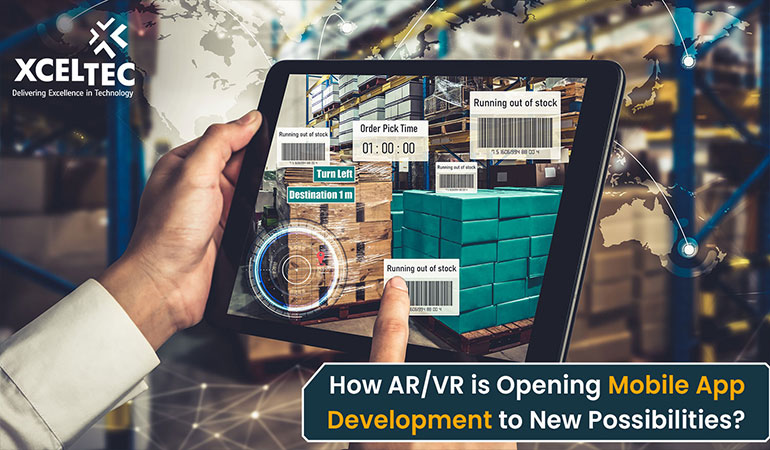
How AR/VR is Opening Mobile App Development to New Possibilities?
How AR and VR Are Opening Mobile App Development to New Possibilities
Mobile applications have transformed the way people communicate, shop, learn, work, and interact with businesses.
As mobile technology continues to evolve, Augmented Reality (AR) and Virtual Reality (VR) are creating new opportunities for businesses and developers to deliver more immersive and interactive experiences.
AR and VR are no longer limited to gaming and entertainment. Today, these technologies are being explored across industries such as retail, healthcare, education, real estate, manufacturing, tourism, automotive, training, and marketing.
By combining immersive technologies with mobile applications, businesses can create experiences that are more interactive, engaging, and personalised.
What Is Augmented Reality?
Augmented Reality adds digital content to the real-world environment.
Unlike VR, AR does not completely replace the physical world. Instead, it enhances what users see through their smartphones, tablets, or AR-enabled devices.
AR can be used to display:
- 3D objects
- Digital information
- Product visualisations
- Navigation elements
- Interactive animations
- Virtual instructions
For example, a furniture application may allow users to see how a sofa or table would look in their home before purchasing it.
What Is Virtual Reality?
Virtual Reality creates an immersive digital environment.
Using compatible devices such as VR headsets, users can interact with a computer-generated environment.
VR applications can be used for:
- Gaming
- Training
- Education
- Virtual tours
- Simulations
- Healthcare
- Product demonstrations
VR provides users with the feeling of being inside a digital environment rather than simply viewing content on a screen.
How AR and VR Are Transforming Mobile App Development
1. More Immersive User Experiences
Traditional mobile applications primarily depend on screens, menus, images, and videos.
AR and VR can make the experience more interactive.
Instead of simply viewing a product, users may be able to:
- View it in 3D
- Rotate it
- Change its appearance
- Place it in their surroundings
- Interact with it
This can help businesses create more memorable customer experiences.
2. New Possibilities for Retail and E-commerce
AR has significant potential in online shopping.
Customers may use AR applications to visualise products before making a purchase.
Examples include:
- Trying virtual clothing and accessories
- Previewing furniture in a room
- Testing makeup virtually
- Viewing products in 3D
- Visualising vehicles
This can help customers make more informed purchasing decisions.
It may also help reduce uncertainty when customers shop online.
3. Revolutionising Mobile Gaming
Gaming is one of the most important use cases for AR and VR.
Mobile games can use AR to combine digital gameplay with the real world.
VR can create fully immersive environments where players can interact with digital worlds.
Modern game developers can create experiences featuring:
- Interactive environments
- Virtual characters
- Multiplayer gameplay
- Real-time interactions
- 3D environments
As mobile hardware continues to improve, immersive gaming experiences are expected to become increasingly sophisticated.
4. Improving Education and Training
AR and VR can make learning more interactive.
Instead of learning only through books or videos, students can explore digital environments.
For example:
- Medical students can explore virtual anatomy models.
- Engineering students can interact with 3D machines.
- History students can explore virtual historical environments.
- Employees can practise workplace procedures in virtual simulations.
This can make complex topics easier to understand and remember.
5. Healthcare Applications
AR and VR are also being explored in healthcare.
Potential applications include:
- Medical training
- Surgical simulations
- Patient education
- Rehabilitation
- Therapy
- Visualisation of medical data
These technologies can help healthcare professionals and patients interact with information in more visual and engaging ways.
6. Real Estate and Virtual Property Tours
Real estate businesses can use AR and VR to improve property experiences.
Potential applications include:
- Virtual property tours
- 3D floor plans
- Virtual staging
- Property visualisation
A customer can explore a property remotely without physically visiting the location.
This can be especially useful for international buyers and customers searching for properties in different cities.
7. Improved Customer Engagement
Businesses constantly look for ways to engage customers.
AR and VR can create experiences that are more interactive than traditional marketing campaigns.
Brands can use immersive technologies to create:
- Interactive product demonstrations
- Virtual events
- 3D advertisements
- Interactive campaigns
- Brand experiences
A unique digital experience can help a business stand out in a competitive market.
AR, VR and the Future of the Metaverse
The concept of the metaverse has increased interest in immersive digital experiences.
Although the metaverse is still evolving, AR and VR are important technologies for creating more interactive digital environments.
Future applications may allow users to:
- Attend virtual events
- Interact with digital products
- Meet people in virtual environments
- Explore virtual spaces
- Participate in interactive experiences
Businesses are exploring how immersive technologies can create new customer experiences and digital opportunities.
The Role of 5G in AR and VR Applications
The growth of high-speed mobile networks is also helping the development of immersive applications.
AR and VR applications can require significant amounts of data, especially when they involve:
- High-quality 3D content
- Real-time interactions
- Cloud processing
- Multiplayer experiences
- Live streaming
Faster and more reliable connectivity can help support more advanced mobile AR and VR experiences.
Cloud computing and edge computing can also help process complex data and deliver immersive content more efficiently.
The Future of AR and VR in Mobile App Development
The future of AR and VR mobile applications will likely focus on:
- More realistic 3D experiences
- AI-powered virtual environments
- Personalised experiences
- Improved wearable devices
- Better mobile performance
- Real-time collaboration
- Spatial computing
Artificial Intelligence can also make AR and VR experiences more intelligent by enabling virtual characters, personalised content, and interactive environments.
As hardware and software continue to improve, developers will have more opportunities to create innovative applications.
How XcelTec Can Help with AR and VR App Development
At XcelTec, we help businesses explore modern technology solutions designed around their specific goals.
Our team can support the development of interactive applications using technologies such as:
- Augmented Reality
- Virtual Reality
- 2D and 3D development
- Mobile applications
- Interactive experiences
- Game development
- AI-powered solutions
We can help businesses transform ideas into engaging digital products for industries such as retail, education, gaming, real estate, healthcare, and more.
The right technology depends on the project requirements, target audience, business goals, and expected user experience.
Conclusion
AR and VR are creating new possibilities for mobile application development.
From immersive games and virtual shopping experiences to healthcare, education, training, and real estate, these technologies are changing the way users interact with digital content.
Businesses that adopt AR and VR strategically can create more engaging experiences, improve customer interaction, and explore new digital opportunities.
However, successful AR and VR development requires more than simply adding 3D features to an application.
It requires a clear concept, suitable technology, strong user experience design, performance optimisation, and professional development.
As mobile devices, artificial intelligence, cloud computing, and high-speed networks continue to evolve, AR and VR are expected to play an increasingly important role in the future of mobile app development.
Are you planning to build an AR or VR mobile application? Contact XcelTec to discuss your idea and explore the right technology solution for your business.
Contact us: +91 987 979 9459 | +1 980 428 9909
Email: sales@xceltec.com
Frequently Asked Questions
1. What is the difference between AR and VR?
Augmented Reality adds digital content to the real-world environment, while Virtual Reality creates a completely computer-generated immersive environment.
2. Can AR and VR be used in mobile applications?
Yes. AR and VR can be integrated into mobile applications for gaming, retail, education, healthcare, real estate, training, marketing, and other industries.
3. What are the benefits of AR and VR for businesses?
AR and VR can help businesses improve customer engagement, create interactive product experiences, support training, improve visualisation, and develop new digital services.
4. Is AR more suitable for mobile apps than VR?
It depends on the application. AR is often suitable for mobile devices because users can interact with digital content using their smartphone cameras. VR generally requires compatible headsets for a fully immersive experience.
5. How does AI support AR and VR applications?
AI can help create intelligent virtual characters, personalised experiences, object recognition, voice interaction, and dynamic digital environments.
6. How can XcelTec help with AR and VR development?
XcelTec can help businesses with the planning, design, development, integration, testing, and optimisation of AR and VR applications based on their specific business requirements.