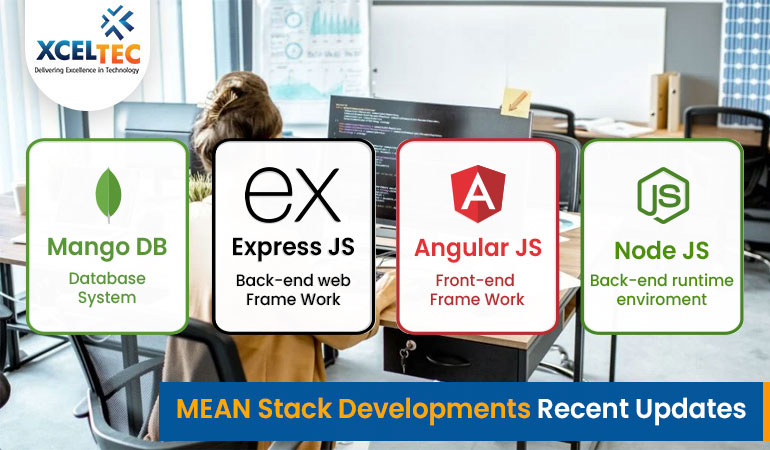
MEAN Stack Developments Recent Updates
Recent Updates and Trends in MEAN Stack Development
The technology landscape is constantly evolving. Businesses today need applications that are fast, scalable, secure, cloud-ready, and capable of supporting changing customer expectations.
As a result, full-stack development continues to play an important role in modern software development.
The MEAN Stack remains a popular technology stack for building modern web applications. MEAN stands for:
- MongoDB – NoSQL database
- Express.js – Backend web framework
- Angular – Frontend framework
- Node.js – JavaScript runtime environment
Together, these technologies allow developers to build complete web applications using a JavaScript and TypeScript-based development ecosystem.
However, modern MEAN Stack development has evolved significantly. New versions, development practices, cloud technologies, AI tools, security requirements, and application architectures are changing the way developers build and manage MEAN applications.
What Is MEAN Stack Development?
MEAN Stack development is a full-stack development approach that combines frontend, backend, server-side, and database technologies.
The typical application structure includes:
Angular
Angular is used to build the frontend interface and user experience.
Node.js
Node.js provides the runtime environment for server-side JavaScript development.
Express.js
Express.js is used to build backend services and APIs.
MongoDB
MongoDB stores application data using a flexible document-based database structure.
Using these technologies together can help development teams build modern applications with a consistent technology ecosystem.
1. Modern Angular Development
Angular continues to evolve with improvements focused on developer productivity and application performance.
Modern Angular development includes features such as:
- Standalone components
- Improved build systems
- Signals-based reactive programming
- Server-side rendering improvements
- Hydration support
- Lazy loading
- Improved tooling
These capabilities help developers create more efficient and maintainable frontend applications.
Modern Angular applications can be designed to improve performance and provide better experiences across desktop and mobile devices.
2. TypeScript Is an Important Part of Modern MEAN Development
Although the MEAN Stack is based on JavaScript technologies, TypeScript has become an important part of modern Angular and Node.js development.
TypeScript provides features such as:
- Static typing
- Better code organisation
- Improved developer tooling
- Easier refactoring
- Better code maintainability
For larger applications, TypeScript can help development teams identify potential errors earlier and maintain complex codebases more effectively.
3. Node.js Continues to Power Scalable Applications
Node.js remains an important part of the MEAN Stack.
Its event-driven architecture makes it suitable for applications that need to handle multiple concurrent operations.
Node.js can be used to build:
- REST APIs
- Real-time applications
- Microservices
- Streaming applications
- SaaS platforms
- Backend systems
It also has access to a large package ecosystem that provides tools for authentication, security, database connectivity, testing, and application development.
4. MongoDB for Flexible Data Management
MongoDB is a document-oriented NoSQL database that is widely used in JavaScript-based application development.
Its flexible data model can be useful for applications where data structures evolve over time.
MongoDB can support:
- Product catalogues
- User profiles
- Content platforms
- Real-time applications
- SaaS applications
- Enterprise systems
Modern MongoDB development also includes features related to cloud databases, analytics, search, and scalable data management.
5. Cloud-Native MEAN Stack Applications
Cloud computing has become an important part of modern application development.
MEAN Stack applications can be designed for cloud environments using:
- Cloud hosting
- Containers
- Serverless services
- Managed databases
- Automated deployment
- Microservices
Cloud-native architecture can help businesses scale applications and manage infrastructure more efficiently.
The right approach depends on the application requirements, traffic, security, budget, and operational model.
6. Microservices Architecture
Traditional applications are often developed as a single large application.
Modern businesses increasingly use microservices architecture for certain types of projects.
A microservices architecture divides an application into smaller services that can operate independently.
For example, an eCommerce application may have separate services for:
- User authentication
- Product management
- Orders
- Payments
- Notifications
Node.js and Express.js can be used to build these individual services.
However, microservices are not automatically the best choice for every project. They introduce additional complexity in areas such as deployment, monitoring, networking, and data management.
7. Real-Time Application Development
Modern users expect real-time digital experiences.
MEAN Stack technologies can be used to build:
- Chat applications
- Live dashboards
- Collaboration platforms
- Tracking systems
- Online gaming applications
- Real-time notifications
Node.js-based technologies can support real-time communication between applications and users.
8. AI Integration in MEAN Stack Applications
Artificial Intelligence is becoming increasingly important in modern application development.
MEAN Stack applications can integrate with AI services to provide features such as:
- AI-powered chatbots
- Intelligent search
- Recommendation systems
- Content generation
- Document processing
- Predictive analytics
- Automated customer support
AI features can be integrated through APIs and specialised services.
Businesses should carefully consider data privacy, security, accuracy, and responsible use when implementing AI capabilities.
9. API-First Development
Modern applications often need to communicate with multiple systems.
API-first development allows businesses to design APIs as important parts of their application architecture.
MEAN Stack developers can build APIs for:
- Web applications
- Mobile applications
- Third-party platforms
- IoT devices
- Enterprise systems
A well-designed API can improve integration and make it easier to connect different digital products.
10. Improved Security Practices
Security is an essential part of modern MEAN Stack development.
Developers need to consider:
- Authentication
- Authorisation
- API security
- Input validation
- Data encryption
- Secure dependency management
- Rate limiting
- Secure database access
Regular updates and security monitoring are also important because applications depend on multiple frameworks and third-party packages.
11. DevOps and Automated Deployment
Modern development teams increasingly use DevOps practices to improve software delivery.
MEAN Stack applications can be integrated with:
- Version control systems
- Automated testing
- Continuous integration
- Continuous deployment
- Containerisation
- Cloud infrastructure
These practices can help teams deliver application updates more consistently.
Skills Required for Modern MEAN Stack Development
A successful MEAN Stack developer should have knowledge of several areas.
Frontend Development
Important skills include:
- HTML
- CSS
- JavaScript
- TypeScript
- Angular
- Responsive design
- UI/UX principles
Backend Development
Developers should understand:
- Node.js
- Express.js
- REST APIs
- Authentication
- Server-side development
Database Development
Knowledge of MongoDB and database design is important.
Developers should also understand:
- Data modelling
- Indexing
- Query optimisation
- Data security
Version Control
Developers should be familiar with Git and collaborative development workflows.
Cloud and DevOps
Modern development increasingly benefits from knowledge of:
- Cloud infrastructure
- Containers
- CI/CD
- Application monitoring
Testing
Testing knowledge can include:
- Unit testing
- Integration testing
- API testing
- End-to-end testing
How XcelTec Can Help with MEAN Stack Development
At XcelTec, we help businesses build modern web applications using MEAN Stack technologies.
Our services can include:
- MEAN Stack web development
- Angular development
- Node.js development
- Express.js API development
- MongoDB development
- Real-time application development
- SaaS application development
- Cloud application development
- AI integration
- Third-party API integration
- Application migration
- Performance optimisation
- Testing and quality assurance
- Maintenance and support
We work with startups, SMEs, and enterprises to develop scalable digital products based on their business objectives.
Conclusion
MEAN Stack development continues to evolve with modern technologies and development practices.
Angular provides powerful frontend capabilities, Node.js supports scalable backend development, Express.js simplifies API development, and MongoDB provides flexible data management.
Together, these technologies can help businesses build modern web applications, SaaS platforms, real-time systems, enterprise applications, and digital products.
The latest trends in MEAN Stack development include cloud-native applications, TypeScript development, AI integration, microservices, API-first architecture, real-time functionality, improved security, and automated deployment.
However, the right technology approach depends on the specific requirements of each project.
At XcelTec, our experienced development team helps businesses select and implement the right technology strategy for their digital products.
Whether you are building a new application, modernising an existing platform, or developing a scalable cloud-based product, our team can help you with customised MEAN Stack development services.
Get in touch with XcelTec to discuss your MEAN Stack development requirements.
Contact us: +91 987 979 9459 | +1 919 400 9200
Email: sales@xceltec.com
Frequently Asked Questions (FAQs)
1. What technologies are included in the MEAN Stack?
MEAN stands for MongoDB, Express.js, Angular, and Node.js. These technologies are used together to build full-stack web applications.
2. Is MEAN Stack suitable for modern web application development?
Yes. MEAN Stack can be used to build modern web applications, SaaS platforms, APIs, real-time applications, enterprise systems, and other digital products.
3. Can AI be integrated into a MEAN Stack application?
Yes. AI features such as chatbots, recommendations, intelligent search, predictive analytics, and content automation can be integrated through APIs and AI services.
4. Can XcelTec help with custom MEAN Stack development?
Yes. XcelTec provides customised MEAN Stack development services, including Angular, Node.js, Express.js, MongoDB, API development, cloud solutions, AI integration, testing, deployment, and ongoing support.