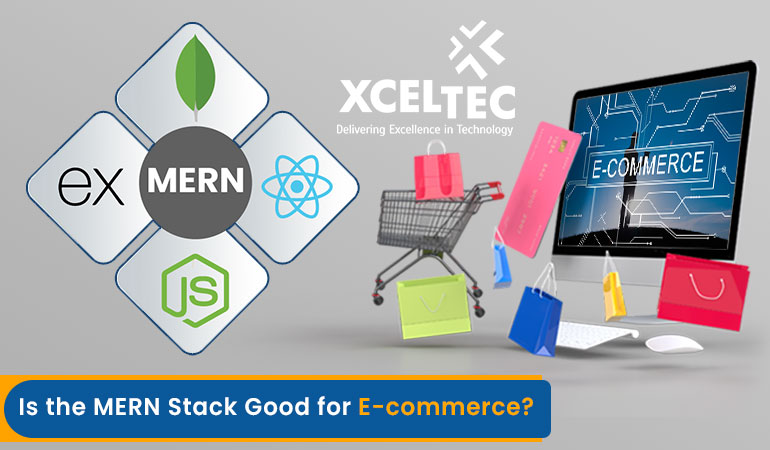
Is the MERN Stack Good for E-commerce?
Why Choose the MERN Stack for E-commerce Website Development?
Choosing the right technology stack is one of the most important decisions when building an e-commerce platform. The technology behind your online store directly impacts its performance, scalability, security, user experience, and long-term maintenance.
An e-commerce platform must handle multiple components, including product catalogues, customer accounts, shopping carts, payment gateways, order management, inventory systems, search functionality, and real-time interactions. Therefore, selecting a flexible and scalable technology stack is essential for building a reliable online shopping experience.
Among the many technologies available today, the MERN stack has become a popular choice for modern e-commerce development.
MERN stands for:
- MongoDB – NoSQL database
- Express.js – Backend web framework
- React – Frontend JavaScript library
- Node.js – JavaScript runtime environment
Together, these technologies enable developers to build modern, high-performance web applications using JavaScript across both the frontend and backend.
What Is the MERN Stack?
The MERN stack is a JavaScript-based technology stack used to develop full-stack web applications.
Each component plays a specific role:
MongoDB
MongoDB is a document-oriented NoSQL database that stores data in flexible JSON-like documents. This structure can be particularly useful for e-commerce applications that manage diverse data, including:
- Product information
- Customer profiles
- Orders
- Reviews
- Inventory records
- Product variations
Express.js
Express.js is a lightweight backend framework built on Node.js. It helps developers create APIs, manage routes, handle requests, and connect different parts of an application.
React
React is used to build interactive user interfaces. E-commerce platforms can use React to create dynamic experiences such as:
- Product filtering
- Shopping carts
- Product recommendations
- Live search
- Checkout interfaces
- Customer dashboards
Node.js
Node.js enables JavaScript to run on the server side. Its event-driven, non-blocking architecture makes it suitable for applications that need to handle many concurrent requests.
Why Choose MERN for E-commerce Development?
1. Faster and More Interactive User Experiences
Modern customers expect e-commerce websites to load quickly and respond instantly to their interactions.
React allows developers to build dynamic interfaces that can update specific parts of a webpage without requiring the entire page to reload. This can create a smoother shopping experience.
For example, when a customer:
- Adds an item to the cart
- Changes a product quantity
- Applies a discount code
- Filters products
- Updates their profile
The interface can respond dynamically, improving usability and engagement.
2. JavaScript Across the Full Stack
One of the major advantages of MERN development is that JavaScript is used across the application stack.
Developers can use JavaScript for:
- Frontend development
- Backend development
- API development
- Database interaction
- Application logic
Using a common programming language across the stack can simplify development and improve collaboration between frontend and backend teams.
It can also reduce the need for developers to switch between multiple programming languages during the development process.
3. Scalable Architecture for Growing E-commerce Businesses
An e-commerce platform needs to scale as the business grows.
As your business expands, you may need to support:
- More customers
- More products
- Higher order volumes
- Multiple regions
- Additional integrations
- Increased website traffic
The MERN stack can support scalable architectures when properly designed and deployed using appropriate infrastructure.
Node.js can handle large numbers of concurrent connections efficiently, while MongoDB can be scaled to support growing data requirements.
The overall scalability of an application depends on several factors, including architecture, database design, hosting infrastructure, caching, code quality, and deployment strategy.
4. Flexible Database Structure with MongoDB
E-commerce platforms often contain different types of products with different attributes.
For example, a clothing product may have:
- Size
- Colour
- Material
- Brand
An electronic product may have:
- Storage
- RAM
- Processor
- Warranty
MongoDB’s flexible document-based structure can make it easier to manage different product attributes and data structures.
This flexibility can be particularly useful for e-commerce businesses that frequently add new product categories and product variations.
5. Suitable for Headless E-commerce Architecture
Modern e-commerce businesses are increasingly adopting headless architecture.
In a headless e-commerce system, the frontend experience is separated from the backend commerce functionality.
This allows businesses to deliver shopping experiences across:
- Websites
- Mobile applications
- Progressive Web Apps
- Kiosks
- Social commerce platforms
- Other digital channels
React can be used to create flexible frontend experiences, while Node.js and Express.js can support backend APIs and business logic.
This flexibility allows businesses to adapt their e-commerce platforms to changing customer behaviour and emerging digital channels.
6. Large Developer Ecosystem
MERN benefits from a large open-source ecosystem.
Developers can access a wide range of:
- Libraries
- Frameworks
- Development tools
- APIs
- Community resources
- Testing solutions
This ecosystem can help development teams accelerate application development and integrate third-party services more efficiently.
MERN applications can also be integrated with services such as:
- Payment gateways
- Shipping providers
- CRM platforms
- Marketing automation tools
- Analytics platforms
- Inventory systems
7. Real-Time Functionality
Modern e-commerce platforms increasingly require real-time features.
Examples include:
- Real-time order tracking
- Live inventory updates
- Customer notifications
- Chat functionality
- Real-time sales dashboards
Node.js can be used with suitable technologies to support real-time communication and event-driven functionality.
This can improve the overall customer experience and help businesses respond to user interactions more efficiently.
8. Cloud and Modern Deployment Compatibility
MERN applications can be deployed using modern cloud infrastructure.
Cloud platforms can provide services for:
- Application hosting
- Database management
- Storage
- Content delivery
- Monitoring
- Security
- Automated deployment
MERN applications can also be packaged and deployed using container technologies such as Docker.
With appropriate architecture, businesses can build systems that are easier to scale and maintain as their traffic and operational requirements increase.
MERN vs. Traditional LAMP: Which Is Better?
LAMP and MERN are different technology stacks with different strengths.
LAMP traditionally consists of:
- Linux
- Apache
- MySQL
- PHP
MERN consists of:
- MongoDB
- Express.js
- React
- Node.js
Neither stack is universally better for every project. The right choice depends on the project’s requirements, existing infrastructure, team expertise, budget, and long-term goals.
However, MERN can be an excellent choice for modern e-commerce platforms that require:
- Highly interactive user interfaces
- Real-time functionality
- Flexible data models
- API-driven architecture
- Cloud deployment
- Cross-platform development
The technology stack should always be selected based on the specific requirements of the business rather than following trends alone.
Important Security Considerations for MERN E-commerce Applications
Technology alone does not guarantee application security.
A secure MERN e-commerce platform should implement appropriate security practices, including:
- Secure authentication
- Strong password hashing
- Input validation
- Protection against injection attacks
- Secure API design
- Proper access control
- HTTPS encryption
- Secure payment gateway integration
- Dependency monitoring
- Regular security updates
Payment information should generally be handled through trusted, compliant payment providers rather than being stored directly within the application unless the required compliance and security controls are in place.
How XcelTec Can Help with MERN E-commerce Development
XcelTec can help businesses build modern e-commerce platforms using scalable technologies and customised architecture.
Our development approach can include:
- E-commerce website development
- MERN stack application development
- Custom API development
- Product and inventory management
- Payment gateway integration
- Third-party API integration
- Customer account systems
- Shopping cart and checkout functionality
- Admin dashboards
- Cloud deployment
- Ongoing maintenance and support
The right architecture depends on your business model, product catalogue, expected traffic, integrations, and future growth plans.
Conclusion
The MERN stack has become a popular choice for developing modern e-commerce platforms because of its flexibility, JavaScript-based development environment, interactive frontend capabilities, scalable architecture, and compatibility with modern cloud infrastructure.
MongoDB provides a flexible database layer, Express.js and Node.js support backend development, and React enables developers to create responsive and engaging shopping experiences.
However, the success of an e-commerce platform depends on more than simply choosing a technology stack. Application architecture, performance optimisation, security, user experience, database design, hosting infrastructure, and ongoing maintenance are equally important.
If you are planning to build a scalable e-commerce website or modern online shopping platform, XcelTec can help you select the right technology and develop a customised solution aligned with your business goals.
Get in touch with us for more!
Contact us on: +91 987 979 9459 | +1 919 400 9200
Email us at: sales@xceltec.com
Frequently Asked Questions
1. Is MERN suitable for e-commerce website development?
Yes. MERN can be suitable for modern e-commerce platforms that require interactive user interfaces, scalable APIs, flexible data management, and cloud-based deployment.
2. What are the main advantages of using MERN for e-commerce?
Key advantages include JavaScript across the full stack, React-based interactive interfaces, flexible data management with MongoDB, scalable backend development with Node.js, and compatibility with modern APIs and cloud infrastructure.
3. Is MERN better than LAMP for e-commerce development?
There is no universally better technology stack. MERN may be a strong choice for modern, highly interactive, API-driven e-commerce platforms, while LAMP can still be appropriate for many projects. The best option depends on the business requirements and technical architecture.
4. Can a MERN e-commerce website integrate payment gateways and third-party services?
Yes. MERN applications can integrate with payment gateways, shipping providers, CRM systems, inventory platforms, analytics tools, and many other third-party services through APIs.