

Why you should choose Ruby on Rails for web app development?
Why Choose Ruby on Rails for Web Application Development?
Choosing the right technology framework is one of the most important decisions when building a modern web application. The right framework can influence development speed, scalability, maintainability, security, and long-term product costs.
Ruby on Rails, commonly known as Rails or RoR, remains a powerful web application framework for businesses that need to build, launch, and continuously improve digital products efficiently. Its convention-driven architecture, mature ecosystem, and developer productivity make it a strong choice for startups, growing businesses, and organisations developing complex web applications.
What Is Ruby on Rails?
Ruby on Rails is an open-source web application framework built with the Ruby programming language. It follows the Model-View-Controller (MVC) architectural pattern and provides developers with an organised structure for building modern web applications.
Rails follows two important principles:
- Convention over Configuration – developers can follow established conventions instead of configuring every aspect of an application manually.
- Don’t Repeat Yourself (DRY) – developers can reduce unnecessary duplication and create more maintainable code.
These principles help development teams build applications with a consistent structure while reducing unnecessary development effort.
Ruby on Rails can be used to build a wide range of solutions, including:
- SaaS platforms
- Business management systems
- E-commerce applications
- Marketplaces
- Content management systems
- Customer portals
- APIs and backend systems
- Data-driven web applications
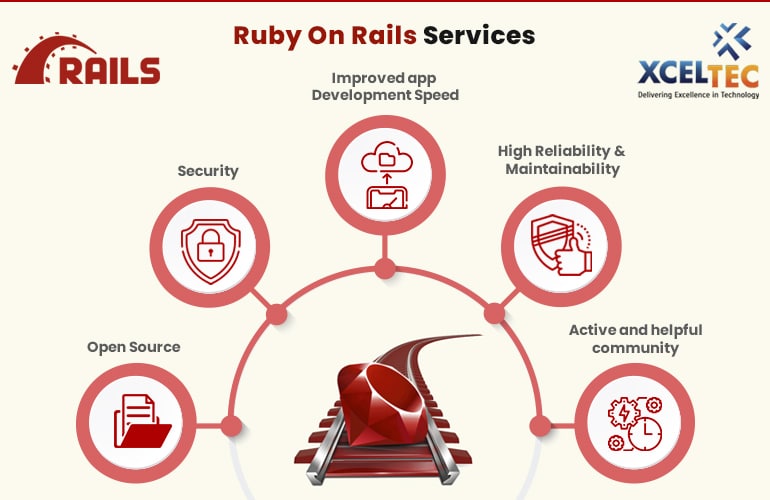
Why Choose Ruby on Rails for Web Application Development?
1. Faster Development and Time to Market
One of the biggest advantages of Ruby on Rails is developer productivity. Rails provides built-in conventions, libraries, generators, database tools, routing systems, and development utilities that help teams build features efficiently.
For businesses, this can help reduce the time required to move from an initial concept to a working product.
This is particularly valuable for startups and businesses that want to:
- Launch an MVP quickly
- Validate a business idea
- Test product-market fit
- Release new features faster
- Respond quickly to customer feedback
Faster development does not mean compromising engineering quality. A well-structured Rails application can provide a strong foundation for future growth.
2. Mature and Powerful Ecosystem
Ruby on Rails has a mature ecosystem supported by a large collection of open-source libraries and tools known as gems.
These libraries can help developers implement common functionality such as:
- Authentication
- Authorisation
- Payment processing
- Background jobs
- File uploads
- API integrations
- Search functionality
- Testing
- Database management
Instead of building every common feature from scratch, development teams can use well-established tools and focus their effort on the unique requirements of the business.
3. Strong Application Security Practices
Security is an important consideration for every web application. Rails includes several built-in security mechanisms and follows established development patterns that help developers address common web application risks.
Depending on the application and configuration, Rails provides tools and protections for areas such as:
- Cross-site request forgery (CSRF)
- SQL injection
- Cross-site scripting (XSS)
- Secure password handling
- Session security
- Input validation
However, no framework automatically makes an application completely secure. Security also depends on secure development practices, proper configuration, dependency management, regular updates, and ongoing security testing.
4. Maintainable Application Architecture
As a business application grows, maintainability becomes increasingly important.
Rails encourages a structured application architecture through MVC and its conventions. This helps development teams organise:
- Business logic
- Data models
- User interfaces
- Routes
- Database interactions
- Application services
A well-organised codebase is easier to understand, test, modify, and extend. This can reduce long-term technical debt and make it easier for development teams to continue working on the application over time.
5. Excellent Support for Testing
Quality assurance is an important part of professional software development. Ruby on Rails supports automated testing and is widely used with testing approaches such as:
- Unit testing
- Integration testing
- Functional testing
- System testing
- Test-driven development (TDD)
Automated tests help development teams identify regressions earlier and make changes with greater confidence.
For businesses, this can be especially valuable when applications contain complex business rules or require frequent feature updates.
6. Suitable for MVPs and Scalable Products
Ruby on Rails is often associated with startup development because of its ability to support rapid product development. However, its use is not limited to small applications.
Rails can support the development of:
- Early-stage MVPs
- Growing SaaS products
- Multi-user platforms
- Marketplace applications
- Enterprise web applications
- API-driven systems
The most suitable architecture depends on the application’s requirements, expected traffic, data model, infrastructure, and engineering strategy. With appropriate architecture and infrastructure planning, Rails applications can be designed to support substantial growth.
7. Strong Developer Productivity
Rails provides developers with a consistent development experience. Its conventions reduce unnecessary architectural decisions and allow teams to focus on business functionality.
This can provide several advantages:
- Faster onboarding for developers familiar with Rails
- Consistent project structure
- Reduced repetitive code
- Faster implementation of common features
- Easier collaboration between team members
For businesses, higher developer productivity can contribute to faster releases and more efficient use of development resources.
Ruby on Rails and API Development
Modern web applications often rely on APIs to connect web interfaces, mobile applications, third-party services, and internal systems.
Ruby on Rails can be used to build API-driven applications and backend services that support:
- Web applications
- Mobile applications
- SaaS platforms
- Third-party integrations
- Microservice architectures
Rails can therefore serve as a backend foundation for modern digital products that operate across multiple platforms.
When Should a Business Choose Ruby on Rails?
Ruby on Rails can be a strong choice when a business needs:
- Rapid application development
- A structured and maintainable codebase
- Strong support for database-driven applications
- A mature development ecosystem
- A framework suitable for MVPs and evolving products
- Efficient development of business applications and APIs
However, technology selection should always be based on the specific project requirements. Factors such as performance requirements, team expertise, application complexity, infrastructure, integrations, and long-term maintenance should all be considered before choosing a framework.
Ruby on Rails Development Services by XcelTec
Businesses often require more than just a framework. They need a technology partner that understands business requirements, product architecture, application development, and long-term maintenance.
XcelTec provides Ruby on Rails development services for businesses looking to build, modernise, or scale web applications.
Our services can include:
- Custom Ruby on Rails web application development
- SaaS application development
- API development and integration
- E-commerce application development
- Ruby on Rails application migration
- Application customisation and feature development
- Rails plugin and gem development
- CMS and portal development
- Application deployment and maintenance
- Performance optimisation and technical support
Our development approach focuses on building solutions that align with business objectives, technical requirements, scalability needs, and long-term product goals.
Conclusion
Ruby on Rails continues to be a capable framework for businesses that need to develop modern, secure, maintainable, and scalable web applications. Its conventions, mature ecosystem, testing capabilities, and emphasis on developer productivity can help organisations reduce development complexity and bring digital products to market efficiently.
For business owners and decision-makers, the key advantage of Ruby on Rails is not simply the framework itself. The real value comes from combining the framework with sound architecture, experienced development practices, effective testing, secure implementation, and a clear long-term technology strategy.
If you are planning to build a new web application, modernise an existing platform, or develop a scalable SaaS product, Ruby on Rails can be a strong technology option to consider. XcelTec can help you evaluate your requirements and develop a Ruby on Rails solution aligned with your business objectives.
Contact XcelTec to discuss your project.
Contact us: +91 987 979 9459 | +91 980 428 9909
Email: sales@xceltec.com
Frequently Asked Questions
1. Is Ruby on Rails still a good choice for web application development?
Yes. Ruby on Rails remains a mature framework with a strong ecosystem, established development conventions, testing support, and capabilities for building modern web applications and APIs. Its suitability depends on the specific requirements of the project.
2. What types of applications can be built with Ruby on Rails?
Ruby on Rails can be used to develop SaaS platforms, e-commerce applications, marketplaces, business management systems, customer portals, content platforms, APIs, and other database-driven web applications.
3. Is Ruby on Rails suitable for startups?
Yes. Rails can be a strong option for startups because its conventions and ecosystem can help development teams build and validate products efficiently. It can support both MVP development and the evolution of products as business requirements grow.
4. How does Ruby on Rails help businesses reduce development time?
Rails provides established conventions, reusable libraries, development tools, database integrations, and a structured application architecture. These features can reduce repetitive development work and help teams implement business functionality more efficiently.