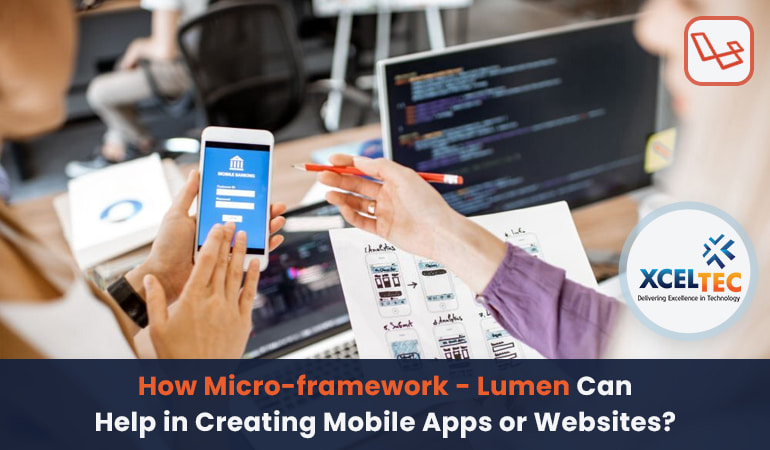
How Micro-framework – Lumen Can Help in Creating Mobile Apps or Websites?
How Lumen Helps Developers Build Fast APIs for Mobile Applications
Mobile applications depend heavily on reliable backend systems. Whether an app is used for e-commerce, food delivery, banking, healthcare, social networking, or enterprise operations, it needs APIs to communicate with databases and backend services.
A mobile application may need APIs for user registration, login, product listings, payments, notifications, order management, and data synchronisation. For these use cases, developers often look for a backend framework that is lightweight, fast, scalable, and easy to configure.
Laravel Lumen was created as a lightweight PHP micro-framework designed primarily for developing APIs and microservices. Built around concepts familiar to Laravel developers, Lumen can be used to create backend services that mobile applications can consume through RESTful APIs.
In this article, we explore how Lumen can support mobile app development, its key capabilities, and the basic installation and configuration process.
What Is Laravel Lumen?
Lumen is a lightweight PHP micro-framework created by Taylor Otwell, the creator of Laravel. It was designed for developing fast APIs and microservices without requiring the complete feature set of a full-stack Laravel application.
A mobile application typically communicates with its backend through APIs. For example, when a user logs into a mobile app, the app sends a request to a backend API. The API validates the credentials, communicates with the database, and returns a response.
Lumen can be used to build these types of backend services.
Common use cases include:
- Mobile application APIs
- RESTful web services
- Microservices
- Backend services
- Lightweight data services
- Third-party integrations
- Cloud-based API applications
Lumen follows many concepts familiar to Laravel developers, including routing, middleware, service containers, configuration, and database integration.
Why Use Lumen for Mobile Application APIs?
1. Lightweight API Architecture
Mobile applications do not necessarily require a complete server-rendered website backend. In many cases, they need a fast API that can process requests and return structured data.
Lumen is designed for this type of use case.
A typical mobile application may communicate with APIs for:
- User registration
- Authentication
- User profiles
- Product data
- Orders
- Payments
- Notifications
- File uploads
- Location services
Lumen can act as the backend layer responsible for processing these requests.
2. Familiar Laravel Ecosystem
One of Lumen’s advantages for Laravel developers is its familiarity.
Developers who already understand Laravel concepts can quickly adapt to Lumen’s architecture. This can reduce the learning curve when building lightweight APIs.
Developers can work with concepts such as:
- Routes
- Middleware
- Controllers
- Service providers
- Dependency injection
- Configuration
- Database connections
This makes Lumen particularly attractive for teams already working with PHP and Laravel.
3. RESTful API Development
Lumen can be used to create RESTful APIs that communicate with mobile applications through HTTP requests.
A typical API may use methods such as:
- GET to retrieve data
- POST to create data
- PUT or PATCH to update data
- DELETE to remove data
The API can return structured JSON responses that can be consumed by Android, iOS, Flutter, React Native, or other mobile applications.
Stateless APIs and Mobile Applications
Lumen was designed primarily for stateless API development.
In a stateless architecture, each request contains the information needed by the server to process that request. The server does not need to maintain a traditional browser session for every user.
This approach is well suited to mobile applications.
For example, a mobile app may authenticate a user and receive an access token. The app can then send that token with subsequent API requests.
This approach can support:
- Mobile authentication
- API access control
- Token-based security
- Mobile sessions
- Secure communication between the app and backend
The exact authentication system should be selected based on the application’s security requirements and architecture.
Installing Lumen for API Development
The installation process depends on the Lumen version and the project’s supported PHP environment. Developers should always use the official documentation and supported installation process for the version they plan to use.
Historically, Lumen projects could be created using Composer-based installation methods.
Composer is the standard dependency manager used by modern PHP applications.
A typical Composer-based workflow involves:
- Installing PHP and Composer.
- Creating or installing the project dependencies.
- Configuring the application environment.
- Connecting the application to a database.
- Creating API routes and controllers.
- Running the application locally.
- Testing the API endpoints.
The exact installation commands may vary depending on the Lumen release and project requirements.
Configuring a Lumen Application
After creating a Lumen project, developers generally configure the application environment using environment variables.
Important configuration areas may include:
- Application environment
- Application key
- Database connection
- Cache configuration
- Queue settings
- External API credentials
- Authentication configuration
A database configuration may include details such as:
- Database type
- Host
- Port
- Database name
- Username
- Password
Sensitive credentials should not be hardcoded into application source files. They should be managed securely through environment configuration and appropriate secret-management practices.
Connecting Lumen with a Mobile Application
Once the API backend is configured, a mobile application can communicate with it through HTTP requests.
For example, a mobile application might send a request to:
- Register a new user
- Authenticate an existing user
- Retrieve a list of products
- Submit an order
- Update a profile
- Upload a document
The Lumen API processes the request and returns a response, usually in JSON format.
This creates a clear separation between the mobile application and the backend.
The mobile application handles the user interface and device functionality, while the Lumen API manages business logic, data processing, authentication, and database communication.
Lumen and Microservices
Lumen can also be used in a microservice architecture.
Instead of building one large backend application, a business can separate functionality into smaller services.
For example, a mobile commerce platform might include:
- Authentication service
- Product service
- Order service
- Payment service
- Notification service
Each service can perform a specific responsibility and communicate with other systems through APIs.
This architecture can improve scalability and allow teams to develop and deploy services independently. However, microservices also introduce additional complexity, including service monitoring, deployment management, security, networking, and data consistency.
Therefore, developers should use microservices when the project’s requirements justify the additional architectural complexity.
Lumen API Development Best Practices
When building APIs for mobile applications, developers should focus on more than simply creating endpoints.
Important practices include:
Secure Authentication
Use secure authentication methods and protect sensitive user information.
Input Validation
Validate incoming data before processing it.
Consistent API Responses
Use consistent response structures so mobile developers can easily handle successful and failed requests.
Error Handling
Return meaningful error responses without exposing sensitive system information.
API Versioning
Versioning can help maintain compatibility when an API evolves.
Database Optimization
Efficient database queries are essential for mobile application performance.
Logging and Monitoring
Monitoring API errors and performance can help teams identify problems quickly.
Is Lumen Suitable for Every Mobile App?
Not necessarily.
Lumen may be suitable for lightweight API services and specific microservice use cases. However, developers should evaluate the long-term requirements of the project before selecting a framework.
If a project requires extensive full-stack features, server-rendered pages, complex sessions, or a broad Laravel ecosystem, a full Laravel application may be more appropriate.
The right choice depends on:
- Project architecture
- API requirements
- Team expertise
- Scalability needs
- Maintenance requirements
- Hosting environment
- Security requirements
Conclusion
Lumen provides a lightweight approach to developing APIs and backend services for mobile applications. Its PHP foundation and Laravel-inspired architecture make it familiar to developers who already work with the Laravel ecosystem.
For mobile application developers, Lumen can serve as a backend layer that manages authentication, business logic, databases, and API communication.
From installation and environment configuration to RESTful API development and microservices, Lumen can support a variety of backend requirements.
However, technology selection should always be based on the specific project. A well-designed architecture, secure configuration, efficient database structure, and properly implemented API are just as important as the framework itself.
If you are planning to develop a mobile application with a scalable API backend, XcelTec can help you plan, develop, and integrate the right technology solution for your business.
Get in touch with us for more!
Contact us: +91 987 979 9459 | +1 919 400 9200
Email: sales@xceltec.com
Frequently Asked Questions
1. What is Lumen used for in mobile app development?
Lumen can be used to build backend APIs that mobile applications use for authentication, database access, user management, payments, orders, notifications, and other business functionality.
2. Is Lumen suitable for Android and iOS applications?
Yes. Lumen APIs can be consumed by Android and iOS applications, as well as cross-platform frameworks such as Flutter and React Native. The mobile application communicates with the Lumen backend through API requests.
3. How is Lumen installed?
Lumen projects are generally created using PHP and Composer-based workflows. Developers install the required dependencies, configure the environment, connect the database, and create API routes and services. The exact installation process depends on the Lumen version being used.
4. Is Lumen better than Laravel for mobile APIs?
Lumen was designed as a lightweight API and microservice framework, while Laravel provides a broader full-stack ecosystem. The best choice depends on the project’s architecture, required features, scalability needs, and long-term maintenance requirements.