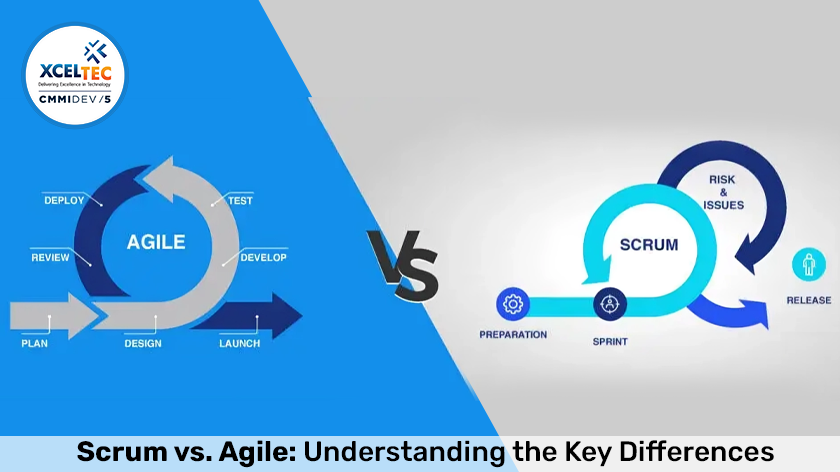
Scrum vs. Agile: Understanding the Key Differences
Scrum vs Agile: Understanding the Key Differences
In modern software development and project management, the terms Agile and Scrum are often used interchangeably. However, Agile and Scrum are not the same thing. While they are closely related, they represent different concepts.
Agile is a broad philosophy and set of principles that guide teams towards flexible, collaborative, and customer-focused project delivery. Scrum, on the other hand, is a structured framework that helps teams apply Agile principles in practice.
For project managers, Scrum Masters, product owners, and development teams, understanding the difference between Agile and Scrum is essential for selecting the right approach and improving project outcomes.
What Is Agile?
Agile is a project management and software development philosophy focused on delivering value incrementally while responding effectively to changing requirements.
Traditional development approaches often depend on detailed planning at the beginning of a project. Agile takes a different approach. Instead of attempting to define everything upfront, Agile teams work in smaller cycles, gather feedback regularly, and continuously adapt their plans.
The Agile approach is based on four fundamental values:
- Individuals and interactions over processes and tools
- Working software over comprehensive documentation
- Customer collaboration over contract negotiation
- Responding to change over following a plan
These values do not mean that processes, documentation, contracts, or planning are unimportant. Instead, Agile prioritises people, working solutions, collaboration, and adaptability when making decisions.
Agile is therefore not a specific process or tool. It is a mindset that can be implemented through different frameworks and methodologies.
Some popular Agile approaches include:
- Scrum
- Kanban
- Extreme Programming (XP)
- Lean Software Development
- Feature-Driven Development (FDD)
What Is Scrum?
Scrum is one of the most popular frameworks used to implement Agile principles.
Unlike Agile, which provides general values and principles, Scrum defines a specific structure for managing complex projects. It establishes roles, events, artefacts, and rules that help teams work collaboratively and deliver value in short development cycles.
Scrum work is divided into time-boxed iterations called Sprints. A Sprint typically lasts between one and four weeks. During each Sprint, the team selects a set of work from the Product Backlog, develops the selected functionality, and delivers a potentially usable product increment.
The Scrum framework includes three key accountabilities:
Product Owner
The Product Owner is responsible for maximising product value and managing the Product Backlog. They help define priorities based on customer needs, business objectives, and market requirements.
Scrum Master
The Scrum Master helps the team understand and apply Scrum effectively. They support collaboration, remove impediments, and help the organisation improve its Agile practices.
Developers
Developers are responsible for creating the product increment. The development team may include software engineers, designers, testers, architects, and other specialists required to deliver the product.
Agile vs Scrum: The Main Difference
The simplest way to understand the relationship is:
Agile is the philosophy. Scrum is a framework for applying that philosophy.
Agile explains the principles that guide adaptive and iterative development. Scrum provides a defined system that teams can use to organise their work.
For example, Agile encourages continuous feedback and adaptability. Scrum implements these ideas through Sprints, Sprint Reviews, Product Backlog refinement, and Sprint Retrospectives.
Key Differences Between Agile and Scrum
1. Scope
Agile is a broad approach to project management and software development.
Scrum is a specific framework within the Agile ecosystem.
Agile can be implemented using several different methodologies, while Scrum provides a defined structure for organising Agile work.
2. Structure
Agile provides general principles and values but does not prescribe specific roles or meetings.
Scrum defines specific roles, events, artefacts, and responsibilities.
For example, Scrum includes:
- Product Backlog
- Sprint Backlog
- Product Increment
- Sprint Planning
- Daily Scrum
- Sprint Review
- Sprint Retrospective
3. Flexibility
Agile is highly flexible. Organisations can adapt Agile principles to their specific requirements and choose the methodology that best suits their project.
Scrum provides greater structure. Teams must follow the core elements of the Scrum framework to maintain its effectiveness.
4. Approach to Delivery
Agile promotes incremental and continuous delivery.
Scrum delivers work through defined Sprints. Each Sprint provides an opportunity to develop, inspect, and adapt the product.
5. Application
Agile principles can be applied across various industries and project management environments.
Scrum is commonly used in software development but can also be applied to marketing, product development, research, education, and other complex work environments.
Agile vs Scrum: Which One Should You Choose?
This is not always an either-or decision.
Scrum is one of the ways an organisation can implement Agile principles. Therefore, an organisation can adopt an Agile mindset and use Scrum as its delivery framework.
Scrum may be a suitable choice when:
- The project is complex
- Requirements may change frequently
- The team needs a clear working structure
- Regular feedback is important
- The organisation wants predictable development cycles
Other Agile frameworks may be more appropriate in different situations.
For example, Kanban may be a better option for teams managing continuous workflows, while Extreme Programming may be useful when technical quality and engineering practices are a primary focus.
The best approach depends on the project’s complexity, team structure, customer expectations, and business objectives.
How DevOps Complements Agile and Scrum
Agile and Scrum primarily focus on collaboration, iterative development, and delivering product value. DevOps extends these principles by connecting development and operations throughout the software delivery lifecycle.
DevOps encourages:
- Automation
- Continuous integration
- Continuous testing
- Continuous delivery
- Infrastructure automation
- Monitoring
- Collaboration between development and operations teams
For Scrum teams, DevOps can improve the process of moving completed work from development into production.
Automated Testing
Automated testing can be integrated into the development process to help identify defects early. This allows Scrum teams to maintain quality while delivering functionality within short Sprint cycles.
Continuous Integration
Developers can frequently integrate code changes into a shared repository. Automated builds and tests help identify integration problems before they become larger issues.
Continuous Delivery
When a product is supported by an effective CI/CD pipeline, completed features can move through development, testing, and deployment more efficiently.
Better Collaboration
DevOps encourages development, testing, security, and operations teams to work together instead of operating in isolated silos.
This creates a stronger connection between development activities and the operational performance of the final product.
The Role of Project Managers and Scrum Masters
Project managers and Scrum Masters play an important role in helping teams understand the difference between Agile principles and Scrum practices.
A Scrum Master should not simply focus on organising meetings. The role also involves helping the team improve collaboration, remove obstacles, understand Scrum, and continuously improve its way of working.
Similarly, project managers working in Agile environments need to understand that planning remains important, but plans must be adaptable.
Successful Agile delivery requires balancing:
- Business objectives
- Customer expectations
- Team capacity
- Technical requirements
- Product quality
- Changing market conditions
Agile does not mean “no planning.” Instead, it encourages planning at the appropriate level and adapting plans when new information becomes available.
Conclusion
Agile and Scrum are closely connected, but they are not the same.
Agile is a broad mindset based on flexibility, collaboration, continuous improvement, customer value, and the ability to respond to change. Scrum is a structured framework that helps teams implement many of these Agile principles through defined roles, events, artefacts, and Sprint-based development.
For project managers and Scrum Masters, understanding this distinction is essential. Agile provides the guiding philosophy, while Scrum provides a practical framework for organising complex work.
When Agile principles and Scrum practices are combined with DevOps automation, continuous testing, continuous integration, and continuous delivery, organisations can create a more efficient software development lifecycle.
The most successful teams do not adopt Agile or Scrum simply because they are popular. They understand the principles behind them, adapt their processes to their specific needs, and continuously improve the way they deliver value.
XcelTec can help organisations improve their software development processes by integrating modern Agile, Scrum, DevOps, and technology practices into their development workflow.
Get in touch with XcelTec to build a more collaborative, efficient, and scalable software delivery process.
Contact us: +91 987 979 9459 | +1 980 428 9909
Email: sales@xceltec.com
Frequently Asked Questions
1. Is Scrum the same as Agile?
No. Agile is a broad mindset and set of principles, while Scrum is a specific framework used to implement Agile principles.
2. Which is better: Agile or Scrum?
Agile and Scrum are not direct alternatives. Scrum is one way to implement Agile principles. The right approach depends on the project, team structure, workflow, and business requirements.
3. What is the role of a Scrum Master?
A Scrum Master helps the team understand and apply Scrum effectively. They support collaboration, remove impediments, facilitate Scrum events, and encourage continuous improvement.
4. How does DevOps work with Scrum?
DevOps complements Scrum by introducing automation, continuous integration, continuous testing, continuous delivery, monitoring, and stronger collaboration between development and operations teams.